One Move. Permanent Consequences.

A rollover is the transfer of funds from one retirement account to another — typically from an employer-sponsored plan (401k, TSP, 403b) to an IRA when leaving a job or retiring. Done correctly, it's completely tax-free. Done wrong, it's one of the most expensive financial mistakes an individual can make.

The IRS classifies rollovers as either direct (trustee-to-trustee — the safest method, no tax consequences) or indirect (a distribution made to you that you redeposit within 60 days — with significant pitfalls). PWR handles every rollover as a direct transfer, manages all paperwork, and briefs clients on every decision point before anything moves.

Start My Rollover Review
01

Direct vs. Indirect: The Method That Changes Everything

Direct rollovers move funds straight to your new custodian — tax-free, untouched, no withholding. Indirect rollovers withhold 20% and give you 60 days to deposit the full amount, or it all becomes taxable. Direct is always better.

02

Which Accounts Can Roll Into Which

Not every account can roll into another. A TSP can move to a Traditional IRA but rarely accepts incoming funds. Roth IRAs accept pre-tax conversions but create taxable income. 457(b) plans' penalty-free withdrawals can be lost if rolled incorrectly.

03

The Inherited Account Exception

Inherited accounts follow different rules. Spouses can roll into their own IRA or stay beneficiaries. Non-spouses must open an inherited IRA, governed by the SECURE Act's 10-year rule. Acting without understanding this risks immediate full taxation.

I

Tax-Free Transfer

A correctly executed direct rollover triggers zero income tax, zero penalties, and zero withholding — regardless of the account size. The entire balance moves intact. This is the foundational promise of every rollover PWR executes.

  • Direct trustee-to-trustee transfer — no withholding
  • Zero taxable event — entire balance preserved
  • No early withdrawal penalty at any age
  • Account grows uninterrupted throughout the transfer process
  • Proper rollover documentation provided for your tax return
II

Full Investment Control

Rolling from an employer plan to an IRA unlocks complete investment control — from two dozen employer-selected funds to thousands of stocks, bonds, ETFs, mutual funds, and alternative assets. This is the most significant investment freedom event in most people's financial lives.

  • Unlimited investment options — not restricted to employer's menu
  • Access to annuities, REITs, sector funds, international exposure
  • Ability to consolidate multiple old 401(k)s into one IRA
  • Full control over asset allocation and rebalancing
  • Direct coordination with advisor going forward — not plan hotlines
III

Strategic Flexibility

An IRA opened from a rollover creates permanent strategic options unavailable inside an employer plan — Roth conversion access, beneficiary designation control, estate planning coordination, and the ability to reposition to an annuity for guaranteed income at any future date.

  • Roth conversion available any year in any amount
  • Beneficiary designation is direct — bypasses probate
  • 1035 exchange to annuity available when income is needed
  • Not subject to employer plan document changes or plan terminations
  • Portable forever — survives any future job changes or career transitions

Every Rollover Type.
Every Rule.
Handled.

401(k) Rollover

The most common rollover in America — and the one most likely to be handled incorrectly. PWR manages the complete 401(k) rollover process: coordinating with your HR department and plan administrator, executing a direct trustee-to-trustee transfer, setting the receiving IRA allocation, and beginning the advisory relationship on day one.

  • Direct transfer from 401(k) to Traditional or Roth IRA
  • Complete paperwork management — from HR to new custodian
  • No 20% withholding — direct transfer only
  • Access to rollover from any previous employer plans — consolidated
  • Investment allocation review and setup on the receiving IRA
  • Roth conversion planning integrated from day one
Start My Rollover

At a glance

$0

Tax triggered on a direct rollover

20%

Withholding on indirect — we eliminate this

Direct

Trustee-to-trustee always

Full

Balance transferred — nothing withheld

Start My 401(k) Rollover

PWR manages the complete process — you provide the authorization, we handle everything else.

schedule a free consultation

TSP Rollover

The Thrift Savings Plan is one of the most valuable retirement accounts a federal employee can hold — and one of the least understood to roll correctly. TSP rollovers require specific forms, specific processing by TSA, and careful coordination to ensure the transfer is clean, direct, and properly allocated at the receiving IRA.

  • TSP rollover to Traditional IRA or Roth IRA
  • Proper completion of TSP-70 / TSP-75 withdrawal forms
  • Direct transfer — not sent via check to avoid withholding
  • Coordination with ongoing FERS pension and Social Security timing
  • Roth TSP funds can roll to Roth IRA tax-free
  • TSP to IRA unlocks investment options not available in TSP
Start My Rollover

At a glance

TSP-70

Form required for full rollover

Direct

Transfer only — never accept a check

Roth TSP

Rolls to Roth IRA tax-free

Weeks

Allow 4–6 weeks for TSP processing

Start My TSP Rollover

The TSP rollover process is slower and more bureaucratic than commercial plans. PWR has handled hundreds.

schedule a free Review

403(b) Rollover

403(b) plans serve non-profit employees, teachers, healthcare workers, and university staff — and often hold legacy annuity products from the 1980s and 90s with surrender charges and outdated investment menus. A rollover to a Traditional IRA after leaving or retiring unlocks modern investment options and begins the Roth conversion strategy.

  • Direct rollover from 403(b) to Traditional IRA
  • Annuity-based 403(b) — surrender charge review required
  • Coordinate timing to minimize surrender charges on rollover
  • Some 403(b) annuities qualify for 1035 exchange into new annuity
  • Investment menu expansion from employer fund selection
  • Roth conversion strategy begins immediately after rollover
Start My Rollover

At a glance

$0

Tax on properly executed direct rollover

Surrender

Charges reviewed before rollover timing

1035

Exchange option for annuity 403(b)s

Modern

Investment options post-rollover

Review My 403(b) Rollover

If your 403(b) has an old annuity with a surrender schedule, timing the rollover correctly can save thousands.

schedule a free reveiew

457(b) Rollover

The 457(b) plan — available to government employees and some non-profit workers — has a unique and often overlooked advantage: there is no 10% early withdrawal penalty at any age. This makes the 457(b) the most flexible employer plan for early retirees or those separating before age 59½ who need to access funds without penalty.

  • No 10% early withdrawal penalty at any age — preserve this advantage
  • Government 457(b) can roll to Traditional IRA or other qualified plans
  • Non-governmental 457(b) has more restrictions — check plan type first
  • Rolling too early loses the penalty-free access advantage
  • Roll after age 59½ when the advantage is no longer unique
  • Coordinate timing with other income sources in year of separation
Start My Rollover

At a glance

No

10% early withdrawal penalty

Gov vs

Non-gov 457(b) have different rules

Flexible

Most accessible employer plan type

Timing

Critical — don't roll before needed

Review My 457(b) Rollover Strategy

The no-penalty access advantage of a 457(b) is too valuable to lose without careful consideration of timing.

schedule a free Review

Pension Lump Sum Rollover

Many pension plans offer a one-time election: take a monthly income for life, or take a single lump sum payment and roll it to an IRA. This is one of the most consequential financial decisions a retiree makes — and the math changes dramatically based on health, life expectancy, other income sources, and the pension's interest rate assumption.

  • Lump sum rolled directly to Traditional IRA within 60 days
  • Full tax deferral maintained — no taxable event on rollover
  • IRA provides investment control and Roth conversion access
  • Compare lump sum present value vs pension income stream carefully
  • Health and life expectancy are critical inputs — this is permanent
  • Annuity inside IRA can replicate pension income if desired
Start My Rollover

At a glance

Permanent

This election cannot be reversed

Lump Sum

Must roll within 60 days — use direct

vs Income

Actuarial break-even analysis required

IRA

Replicates pension flexibility with control

Model My Pension Lump Sum vs Monthly Income

This is the most consequential retirement decision most people face — get the full analysis first.

schedule a free review

Inherited Account Rollover

Inheriting a retirement account triggers a fundamentally different set of rules than leaving a job. Spouse beneficiaries have significant flexibility — including rolling to their own IRA. Non-spouse beneficiaries generally must open an inherited IRA in the decedent's name and cannot combine it with their own accounts. Contact PWR before taking any distribution.

  • Spouse inheritor can roll to own IRA or remain beneficiary
  • Non-spouse opens inherited IRA — titled in decedent's name
  • SECURE Act 10-year rule applies to most non-spouse beneficiaries
  • Cannot contribute additional funds to inherited IRA
  • RMD rules differ based on whether original owner had begun distributions
  • Roth inherited IRAs allow tax-free distributions within the 10-year period
Start My Rollover

At a glance

Spouse

Can roll to own IRA — most flexible

10 Year

Rule for most non-spouse beneficiaries

0%

Tax on inherited Roth distributions

Contact

PWR before taking ANY distribution

Get Inherited Account Guidance

Inherited account rules changed dramatically in 2020. Any distribution or action before understanding the rules risks full taxation.

Schedule a Free Review

Four Steps. Zero Tax Events.

Document Review

PWR Retirement Group reviews your current plan statement, the plan document provisions, your beneficiary designations, and any surrender charge schedules — before recommending a rollover structure or timing.

Contact Plan Administrator

We initiate the rollover process on your behalf — contacting your HR department or plan administrator, completing all required distribution forms, and coordinating the direct transfer to your new IRA custodian.

Direct Transfer Execution

Funds move directly from your plan to the receiving IRA — trustee to trustee, no check issued, no withholding triggered, no 60-day clock started. You authorize it once; we manage the paperwork chain entirely.

Investment Setup & Strategy

Your new IRA is immediately allocated according to your risk profile and time horizon. Roth conversion strategy is modeled. Beneficiary designations are set. Advisory relationship begins on day one — not after the paperwork settles.

Find Your Optimal Rollover Path

Choose your source account and situation — the eligibility matrix updates live. Green = tax-free path. Amber = partial tax or restrictions. Red = triggers taxable income. Gray = not eligible.

Step 1
What account are you moving?
Step 2
What is your situation?
Select source account to see rollover paths
Tax-free direct rollover Partial eligibility / restrictions Triggers taxable income Not eligible from this source
App feature

Reasons to Download Our Application Today

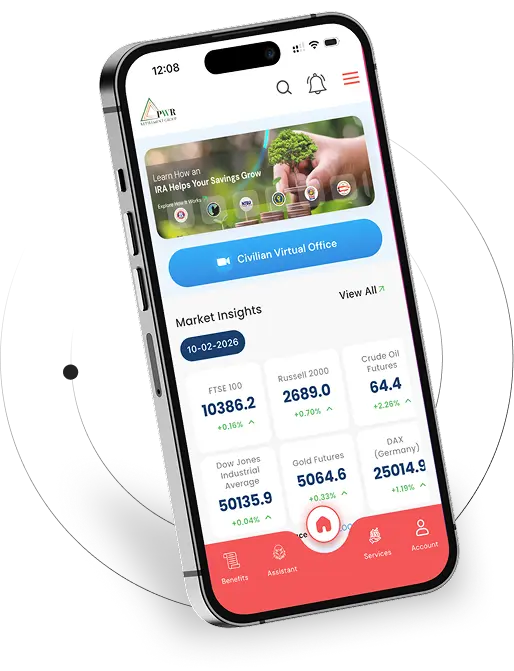
  • PWR puts your retirement planning, benefits guidance, and financial tools in one secure app. Access everything easily, track your progress in real time.

  • Every financial journey is different. PWR focuses on your goals, benefits, and timeline—delivering guidance built around you, not a generic plan.

  • PWR gives you access to workshops, live events, and podcasts that simplify complex financial topics into clear, practical insights.

Download The PWR App Now

Build A Rollover Strategy Designed Around Your Accounts Income, And Future.

Rollovers aren't simply about transferring money between accounts. They involve understanding eligibility rules, avoiding tax traps, coordinating timing, and selecting the right path to protect your retirement savings for the long term.

Guidance
For Your Most Common Questions

ask an advisor

A rollover is the process of moving retirement funds from one qualified account to another without treating the transfer as a regular withdrawal. People often use rollovers when they change jobs, retire, or want more control over investment choices. Common rollover options include moving funds from a 401(k), TSP, or other employer-sponsored plan into an IRA. The right choice depends on taxes, investment options, fees, retirement goals, and your income needs.

The most common types include direct rollover, indirect rollover, IRA-to-IRA rollover, 401(k)-to-IRA rollover, and employer-plan-to-employer-plan rollover. Each option has different rules, timing requirements, and tax considerations. A direct rollover is often preferred because the money moves straight between institutions. This may reduce the chance of mistakes, missed deadlines, or unexpected withholding that could affect your retirement savings.

If you are wondering how to rollover 401k to IRA, the process usually starts by opening or selecting an IRA, contacting your current plan provider, and requesting a direct rollover to the new custodian. This helps keep the funds within a retirement account. Before moving money, review investment options, fees, tax treatment, and withdrawal rules. A rollover should support your long-term retirement strategy, not just simplify accounts.

A rollover may not be taxable when it is completed properly between qualified retirement accounts. For example, moving pre-tax funds into a traditional IRA through a direct rollover is generally designed to preserve the tax-deferred status of the money. However, taxes may apply if funds are converted to a Roth account, withdrawn personally, or handled incorrectly. Anyone considering a tax-free 401k rollover in Puerto Rico should review local and federal tax rules before making a decision.

A TSP rollover to IRA allows eligible federal employees or retirees to move funds from the Thrift Savings Plan into an Individual Retirement Account. This may provide broader investment choices, customized income planning, and more flexible account management. However, TSP has unique features, low costs, and specific withdrawal rules. Before rolling over, compare both options carefully so the decision supports your retirement income, tax planning, and beneficiary goals.

A direct rollover sends retirement funds from one institution directly to another, helping avoid personal handling of the money. This is usually the cleaner option because it reduces timing problems and withholding issues. An indirect rollover sends the money to you first, and you must redeposit it into another qualified account within the required deadline. If not completed correctly, it may become taxable and could trigger penalties depending on your age.

You may consider a rollover after leaving a job, retiring, consolidating accounts, seeking more investment choices, or wanting a retirement income strategy that fits your current goals. It can also help simplify account tracking. Still, a rollover is not always the best move. Compare fees, investment access, creditor protections, tax impact, withdrawal flexibility, and beneficiary options before transferring retirement funds.