The Account That Changes Everything.

An Individual Retirement Account (IRA) is a tax-advantaged account that allows you to save for retirement with either a tax deduction today (Traditional) or tax-free withdrawals later (Roth). Choosing the right type — and managing it strategically — is one of the most impactful decisions in your retirement plan.

The mechanics are simple. The strategy is anything but. Which type to use, when to convert, how to coordinate with your 401(k), when to take RMDs, and how to structure the account for your beneficiaries — these decisions collectively determine whether your IRA works for you or for the IRS.

Get My Tax Strategy Review
01

Traditional vs. Roth: The Core Decision

Traditional IRAs deduct now, tax later. Roth IRAs skip the deduction but never tax withdrawals or growth. The right pick depends on your current rate versus your future one — Traditional suits peak earners, while Roth often wins during lower-income years.

02

The Roth Conversion Window: Most People Miss It

Between retirement and age 73, many hit their lowest lifetime tax bracket — the Roth conversion window. Converting Traditional IRA funds now means paying tax at a low rate, then owing nothing on that money again. The window exists; few use it strategically.

03

Required Minimum Distributions: The Forced Withdrawal Problem

Traditional IRAs require distributions starting at 73, forcing taxable income whether you need it or not. This often raises tax brackets, triggers IRMAA surcharges, and taxes Social Security. Roth conversions before 73 reduce your IRA balance, potentially eliminating RMDs entirely.

I

Tax Deduction Now

Traditional IRA contributions reduce your taxable income in the year made — dollar for dollar, up to the contribution limit. For a married couple in the 24% bracket contributing the maximum, that's a $1,920 tax reduction per year, every year, during the accumulation phase.

  • Reduces current-year federal and state income tax
  • Deductible up to $7,000 ($8,000 over 50) per person in 2024
  • Deductibility phases out at higher income if workplace plan exists
  • Growth inside the account is tax-deferred — no annual capital gains tax
  • Ideal during peak earning years when current bracket is at its highest
II

Tax-Free Forever

Roth IRA qualified withdrawals — contributions AND all growth — are completely federal-tax-free. There are no RMDs. The account continues to grow tax-free during your lifetime, and passes to beneficiaries who receive tax-free distributions for up to 10 years.

  • Contributions withdrawn any time — no age restriction, no penalty
  • All investment growth is completely tax-free at qualified withdrawal
  • No required minimum distributions — ever — during the owner's lifetime
  • Passes to heirs with continued tax-free growth for 10 years
  • Ideal when current bracket is lower than expected retirement bracket
III

Tax-Deferred Control

Both Traditional and Roth IRAs give you control over your investments, your beneficiaries, your withdrawal timing, and your estate outcome — that a workplace 401(k) or pension plan cannot match. This control is the ultimate advantage of IRA ownership.

  • Full investment control — not limited to employer's fund menu
  • Beneficiary designations bypass probate — direct transfer to heirs
  • No employer dependency — account survives any job change
  • Withdrawal flexibility beyond RMD minimums — take more or less
  • Convertible to Roth in any year, in any amount, at your discretion

Six Structures.
One Right
for You.

Traditional IRA

The Traditional IRA is the most widely held retirement account in the U.S. — but most holders don't manage it with a clear tax strategy. PWR ensures Traditional IRA assets are correctly positioned, coordinated with other accounts, and sized to minimize lifetime taxes rather than simply accumulate.

  • 2024 contribution limit: $7,000 ($8,000 age 50+)
  • Deductible contributions if income and plan participation allow
  • Tax-deferred growth — no annual capital gains or dividend tax
  • RMDs begin at age 73 — planning starts years before
  • Penalty-free withdrawals at 59½ for any purpose
  • Eligible for Roth conversion in any year at any amount
Get a Strategy Review

At a glance

$7K

2024 annual contribution limit

Age 73

RMDs begin — plan well before

Deduct

Current-year tax reduction

Convert

To Roth any time, any amount

Review My Traditional IRA Strategy

Coordinate your Traditional IRA with your other accounts and model the optimal Roth conversion timeline.

schedule a free Review

Roth IRA

The Roth IRA is the most tax-efficient vehicle in the U.S. tax code for retirement savings. Properly funded and managed, it creates a pool of completely tax-free money that benefits the account owner and their heirs for decades — with no RMDs, no income tax on growth, and complete withdrawal flexibility.

  • Tax-free growth — contributions AND gains withdraw tax-free
  • No required minimum distributions — ever
  • Contributions can be withdrawn any time without penalty
  • 2024 limits: $7,000 ($8,000 over 50) — phases out at higher income
  • Backdoor Roth available for high earners above income limits
  • Ideal legacy vehicle — heirs receive distributions tax-free for 10 years
Get a Strategy Review

At a glance

0%

Tax on qualified withdrawals forever

No RMD

Never forced to take distributions

Backdoor

Option for high-income earners

Legacy

Tax-free to heirs for 10 years

Maximize My Roth IRA

Are you using backdoor contributions? Optimizing the conversion window? Coordinating with your estate plan?

schedule a free review

SEP IRA

The SEP-IRA (Simplified Employee Pension) is the highest-limit, simplest-to-administer retirement account available to self-employed individuals and small business owners. In 2024, you can contribute up to $69,000 — more than 9x the Traditional IRA limit — with a single annual contribution.

  • 2024 limit: $69,000 or 25% of net self-employment income
  • Contributions 100% tax-deductible — immediately reduce taxable income
  • No contribution deadlines until tax filing due date (including extensions)
  • Zero administrative burden — no filings, no ERISA compliance
  • Must cover all eligible employees if operating a business
  • Eligible for Roth conversion like any Traditional IRA balance
Get a Strategy Review

At a glance

$69K

2024 maximum annual contribution

25%

Of net self-employment income

Simple

No ERISA filings or admin

Deadline

Until tax filing due date

Design My SEP-IRA Strategy

For self-employed professionals, a SEP-IRA is the highest-impact retirement contribution available.

schedule a free Review

SIMPLE IRA

The SIMPLE IRA (Savings Incentive Match Plan for Employees) provides small businesses with a streamlined, low-cost way to offer retirement benefits — with both employee salary deferrals and employer matching contributions, at a fraction of the complexity of a 401(k).

  • Employee deferral limit: $16,000 in 2024 ($19,500 age 50+)
  • Employer required to match — 2% for all or 3% matching employees
  • Significantly simpler than 401(k) — minimal administrative burden
  • Two-year rule before funds can be transferred to another IRA
  • Ideal for small businesses with 100 or fewer employees
  • Must be the business's only qualified plan in the calendar year
Get a Strategy Review

At a glance

$16K

2024 employee contribution limit

3%

Employer match requirement

100

Maximum eligible employees

Simple

Minimal plan administration

Explore SIMPLE IRA for My Business

Retain talented employees and reduce business taxes with a SIMPLE IRA built for your team.

schedule a free Review

Inherited IRA

Inheriting an IRA triggers a complex set of rules that vary based on your relationship to the deceased, the type of IRA inherited, and when the original owner passed. Misunderstanding the 10-year rule, RMD obligations, or spousal continuation rights can cause unnecessary taxation of the entire account.

  • Spouse beneficiaries have unique rollover and continuation rights
  • Non-spouse beneficiaries must deplete the account within 10 years
  • Annual RMDs required within the 10 years if owner had begun RMDs
  • Roth inherited IRAs follow the same 10-year rule — but distributions are tax-free
  • Inherited IRA cannot receive additional contributions
  • Naming a trust as beneficiary creates additional rules — coordinate with estate plan
Get a Strategy Review

At a glance

10 Year

Non-spouse beneficiary rule

0%

Tax on inherited Roth distributions

Spouse

Continuation rights — special rules

Trust

As beneficiary — complex rules apply

Get My Inherited IRA Guidance

Inherited IRA rules changed significantly in 2020. Are you distributing correctly?

schedule a free Review

Backdoor Roth IRA

The backdoor Roth IRA is a legal strategy that allows high-income earners — above the Roth income limits — to make Roth IRA contributions indirectly. A non-deductible Traditional IRA contribution is made, then converted to Roth, creating tax-free growth with no income limit restriction.

  • Available to any earner — no income limit for the strategy itself
  • Non-deductible Traditional IRA contribution followed by immediate conversion
  • No tax owed on the conversion if no prior pre-tax IRA balances (Pro-Rata Rule)
  • Super-backdoor Roth available through some 401(k) plans — up to $43,000
  • Must execute carefully to avoid Pro-Rata Rule creating unexpected taxes
  • Coordinate with CPA for Form 8606 filing to document the basis
Get a Strategy Review

At a glance

No Cap

Available at any income level

$7K

Maximum annual backdoor amount

Pro-Rata

Rule must be managed carefully

Form

8606 required — PWR coordinates

Implement My Backdoor Roth

High earners are leaving tax-free money on the table by not using this strategy every year.

schedule a free Review

IRA Strategy Changes Every Decade

Start Roth — Low Bracket, Long Horizon
  • Roth IRA is almost always optimal — early career brackets are at their lowest
  • $7,000/year in a Roth IRA at 25 becomes $150,000+ tax-free by 65 at 7% growth
  • Open and fund your Roth IRA every year — even if contributing to a 401(k)
  • Consider backdoor Roth if income exceeds limits earlier than expected
Roth First, Then Employer Match
  • Max Roth IRA contribution annually — $7,000 ($8,000 over 50)
  • Capture 100% of employer 401(k) match — that's an instant 50–100% return
  • SEP-IRA if self-employed — every dollar saved early compounds dramatically
  • Automate contributions — the biggest mistake is failing to start
Build Tax Diversification Early
  • Having both Traditional (401(k)) and Roth (IRA) creates tax flexibility later
  • Don't overthink the Traditional vs Roth choice — just start contributing
  • Update beneficiary designations immediately — these pass outside probate
  • Coordinate with any employer HSA — another tax-free account to stack
Maximize Deductible Savings, Plan for Conversion
  • In the 24–32% bracket, Traditional IRA and 401(k) deductions have maximum value
  • Maximize all available tax-deferred contributions — IRA, 401(k), SEP, SIMPLE
  • Begin identifying when the Roth conversion window will open after retirement
  • SEP-IRA or Defined Benefit Plan if self-employed — contributions can exceed $100K/yr
Catch-Up Contributions + Coordination
  • Age 50+ catch-up: $8,000 IRA limit, $30,500 401(k) limit in 2024
  • Backdoor Roth IRA if income exceeds Roth direct contribution limits
  • Consider whether high-income years justify a partial Roth conversion anyway
  • Model IRMAA thresholds — large conversions in retirement can spike Medicare costs
Build the Conversion Strategy Now
  • Map the gap between retirement and age 73 — that's your conversion window
  • Identify if you'll have a pension, Social Security, or part-time income in early retirement
  • Begin modeling what bracket your retirement income falls into — without conversions
  • Start coordinating with your CPA annually — conversion strategy needs tax-return visibility
Convert Before RMDs Begin at 73
  • This is the most valuable tax planning window of most people's financial lives
  • Without RMDs yet, income often drops to its lowest level in decades
  • Every dollar converted at 12–22% now avoids 24–32% taxation on RMDs later
  • IRMAA can be triggered if conversions push income over $103K (single)/$206K (MFJ)
Annual Conversion Up to Bracket Top
  • Calculate annual conversion to 'fill up' the current bracket — stop there
  • Model IRMAA thresholds carefully — one bracket jump can cost $3,000+ in Medicare
  • Consider QCDs (Qualified Charitable Distributions) after 70½ to satisfy RMDs tax-free
  • Inherited IRAs from deceased spouses can be combined or converted if advantageous
Execute the Conversion Plan Annually
  • PWR prepares a conversion schedule at the beginning of each calendar year
  • Review in Q4 with CPA to finalize the conversion amount before Dec 31
  • Coordinate with Social Security timing — delay often means more conversion room
  • Update Roth IRA beneficiary designations — these now represent significant wealth
Manage RMDs — Minimize Tax Impact
  • RMDs are mandatory — the question is how to minimize their tax impact
  • QCDs (Qualified Charitable Distributions) satisfy RMDs tax-free up to $105K/yr
  • If RMDs exceed income needs, reinvest in a taxable account or Roth (if still working)
  • Roth IRA has no RMDs — this asset now provides maximum flexibility in legacy planning
QCDs, Roth, and Legacy Coordination
  • Use QCDs for any charitable giving — eliminates income tax on that RMD amount
  • Withdraw more than the minimum in low-income years — proactive drawdown saves heirs
  • Review beneficiary designations — inherited IRA 10-year rule planning begins now
  • Consider annuitizing a portion of the IRA for guaranteed income + reduced RMD exposure
Coordinate IRA, Estate, and Legacy Plan
  • PWR models the optimal RMD drawdown alongside portfolio, annuity, and Social Security
  • Name specific beneficiaries with a clear plan for the 10-year inherited distribution
  • Consider QLAC inside the IRA — defers up to $135K in RMD calculations
  • Coordinate with estate attorney — IRA beneficiary trusts require specific language

Find Your Optimal Conversion Window

Adjust inputs to model your Roth conversion strategy. Estimates only—advisors refine with full tax data.

Current Tax Bracket
22%
Expected Retirement Bracket
24%
Optimal Annual Conversion
$50,000
Per year to stay in current bracket
Total Tax Cost to Convert
$88,000
Paid over the full conversion window
Effective Conversion Rate
22.0%
Average tax rate on converted funds
20-Year After-Tax Advantage
$24K
Extra wealth vs waiting for RMDs
Year-by-Year Conversion Plan

Optimal Annual Conversion: $50,000/yr

Annual conversion amount Tax cost per year
Total Converted $400,000
Total Tax Paid $88,000
Effective Rate 22.0%
Vs Retirement Bracket 24.0%
20-Year After-Tax Wealth Projection

Convert Strategically vs Wait for RMDs

Convert Strategically
Wait for RMDs
$24K

Projected lifetime tax savings from converting now vs being taxed on RMDs later.

App feature

Reasons to Download Our Application Today

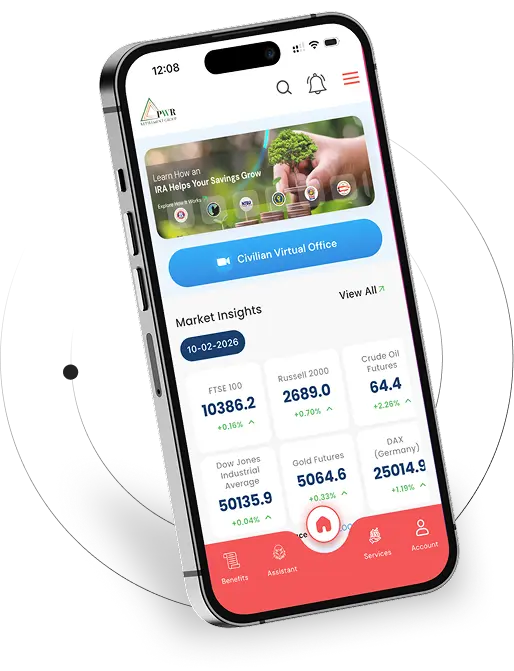
  • PWR puts your retirement planning, benefits guidance, and financial tools in one secure app. Access everything easily, track your progress in real time.

  • Every financial journey is different. PWR focuses on your goals, benefits, and timeline—delivering guidance built around you, not a generic plan.

  • PWR gives you access to workshops, live events, and podcasts that simplify complex financial topics into clear, practical insights.

Download The PWR App Now

Build A Tax Reduction Strategy Designed Around Your Income, Assets, And Future.

Tax reduction is not about waiting until filing season. It is about planning ahead, organizing your income, reviewing deductions, coordinating retirement accounts, and identifying legal strategies that may help reduce unnecessary tax pressure over time.

Guidance
For Your Most Common Questions

ask an advisor

An IRA is a personal retirement account that can help you save with tax advantages while giving you more control over your long-term strategy. Unlike some employer plans, an IRA can often stay with you even when your job, income, or retirement goals change. For many people in Puerto Rico, an IRA can support retirement income planning, tax coordination, beneficiary planning, and rollover decisions. The right IRA strategy depends on your age, income, timeline, and how you want your money to work in retirement.

Choosing the best IRA in Puerto Rico is not only about finding an account with low fees. You should also review investment options, tax treatment, withdrawal rules, service quality, beneficiary features, and how the IRA fits your full retirement plan. The best option depends on your purpose. Some people want tax-deferred growth, others want future tax flexibility, and some need rollover support from an old employer plan. A careful review can help you avoid selecting an IRA that looks good but does not match your goals.

The most common IRA options include Traditional IRAs, Roth IRAs, SEP IRAs, and SIMPLE IRAs. A Traditional IRA may offer tax-deferred growth, while a Roth IRA may provide future tax-free qualified withdrawals. SEP and SIMPLE IRAs are often used by business owners or self-employed professionals. Each IRA type has different contribution rules, tax treatment, income limits, and withdrawal considerations. Before choosing one, it is important to understand whether your goal is current tax reduction, future income flexibility, business retirement planning, or long-term wealth transfer.

Yes, many people may use both a Roth IRA and a 401(k) as part of their retirement strategy, depending on eligibility and contribution rules. A roth ira 401k approach can help diversify how retirement income may be taxed in the future. A 401(k) is usually connected to an employer, while a Roth IRA is individually owned. Having both may create more flexibility in retirement, but contribution limits, income rules, employer matching, and withdrawal timing should be reviewed before deciding how much to place in each account.

The best IRA services in Puerto Rico should help you understand more than where to open an account. A strong service should review your retirement goals, income needs, rollover options, tax considerations, investment comfort, and beneficiary planning. Good IRA guidance should also explain the difference between Traditional and Roth options, how withdrawals may affect retirement income, and whether your current account structure still makes sense. The goal is to build an IRA strategy that supports your future, not just open another financial account.

You may consider an IRA rollover after leaving an employer, retiring, changing jobs, or wanting more control over your retirement assets. A rollover may help simplify scattered accounts and create a more organized retirement income strategy. Before moving money, review fees, investment choices, tax impact, withdrawal rules, and whether the current employer plan offers benefits worth keeping. A rollover should never be done just for convenience. It should serve a clear purpose within your larger financial plan.

A Roth IRA is not automatically better than a Traditional IRA. The better choice depends on your income today, expected tax situation in retirement, eligibility, cash flow, and long-term goals. A Roth IRA may be useful if you want future qualified withdrawals to be tax-free. A Traditional IRA may make sense if you want tax-deferred growth and possible current tax advantages. Many retirement plans use both account types to create flexibility. The right decision should be based on your numbers, not general advice.

Your IRA strategy should be reviewed at least once a year or whenever your financial life changes. Job changes, income increases, retirement timing, tax law updates, market shifts, marriage, business ownership, or beneficiary changes can all affect how your IRA should be managed. A regular review helps confirm whether your contributions, investments, rollover decisions, withdrawal plan, and beneficiary designations still match your goals. An IRA is not a set-it-and-forget-it account. It should evolve as your retirement plan becomes clearer.