The concept is not about getting rich quickly. It is about capturing a structural advantage: when you borrow from yourself instead of a bank, the interest you pay goes to your own policy, not to a third-party lender. Over decades and multiple loan cycles, this recaptured interest compounds — producing a meaningfully higher lifetime net worth than the traditional financing model. PWR designs IUL policies specifically optimized for maximum cash value accumulation and banking efficiency.
Design My Personal BankThe entire Power Banking strategy depends on a specific policy design feature called non-direct recognition. In a non-direct recognition policy, the insurance carrier credits interest on the full face value of the cash value account — regardless of whether a portion of it is pledged as collateral for a policy loan. This means that if your cash value is $200,000 and you borrow $80,000 against it, you are still earning credited returns on the full $200,000 — not just on the $120,000 net.
Traditional Power Banking strategies use dividend-paying whole life insurance. The PWR Power Banking Concept uses Indexed Universal Life (IUL) because it offers a zero-floor guarantee (no downside in negative market years), index-linked growth potential that can exceed whole life dividends in strong markets, and significantly more premium flexibility. The IUL also provides a larger death benefit per premium dollar — an important consideration for clients who also need life insurance protection.
The cycle has four steps: (1) Deposit premiums — cash value grows tax-deferred. (2) Borrow against cash value for a purchase, investment, or business expense. (3) Repay the loan — with interest to your policy carrier — on your own schedule. (4) Loan balance is eliminated, cash value has never stopped compounding, and the policy is replenished as a lending source for the next cycle. Every repayment recapitalizes the bank.
The fundamental advantage of the Power Banking Concept is continuity of compounding. In a conventional financing model, capital deployed into a purchase stops earning returns until the loan is repaid. In a Power Banking model, the policy's full cash value earns indexed credits continuously — even while a portion is lent out. The same dollar is simultaneously serving as collateral and earning a return.
When you repay a bank loan, the interest payment disappears permanently — it is income to the bank, gone from your financial system. When you repay a policy loan, the interest stays inside your personal banking system. The carrier charges you a loan rate; you can choose to repay at a higher rate, with the difference credited to your policy's value. Over multiple loan cycles across 20–30 years, this recaptured interest compounds into a significant wealth differential.
Policy loans are not classified as income under the Internal Revenue Code — they are a loan against collateral (your cash value). You receive the funds without a 1099, without income tax owed, without triggering a taxable event. Used as a retirement income supplement, policy loans provide tax-free cash flow that does not interact with Social Security taxation, Medicare IRMAA thresholds, or RMD income calculations.
Not every IUL policy is built for Power Banking. Banking-optimized IUL policies are designed with minimum face amounts, maximum premium funding, and non-direct recognition loan provisions that allow the full cash value to earn credited interest during loan periods. PWR designs every Power Banking IUL from the ground up for maximum banking efficiency — not for maximum death benefit or maximum insurer commission.
At a glance
Cash value per premium dollar
Policy design essential for banking
Floor — no market downside
Carrier analysis required
The policy design determines the strategy's effectiveness — every structural decision matters.
Schedule a Free Strategy SessionAuto loans are among the most expensive forms of recurring financing for most households — and among the most replaceable with the Power Banking Concept. A family that finances 5–6 vehicles over a lifetime through conventional auto loans will pay $80,000–$120,000 in interest to banks. The same family, using policy loans to purchase each vehicle and repaying the loan to their own policy, recaptures that interest into a compounding asset.
At a glance
Avg auto loan interest over a lifetime
Every dollar stays in your policy
Check — ever — for policy loans
Per lifetime — all recaptured
See how many auto loans you can eliminate from the bank's ledger — and add to your own.
Schedule a Free Strategy SessionPolicy loans used as real estate down payments allow a buyer to deploy capital into a property without depleting a savings account — and while the policy's cash value keeps compounding. When the property appreciates and the loan is repaid from rental income or sale proceeds, the policy is recapitalized at full value, ready for the next real estate transaction.
At a glance
Leverage — property + policy both compound
Approval for the down payment capital
Repays the policy loan on your schedule
Capital for the next property
See how policy loans as down payments interact with rental income and property appreciation.
Schedule a Free Strategy SessionBusiness owners can use policy cash value as working capital, equipment financing, or bridge capital during cash flow gaps — without going to a bank, pledging business assets, or disrupting their personal credit profile. The business owner repays the policy from business revenue, recapturing the financing cost that would otherwise leave the economic system.
At a glance
Approval for working capital
Capital on your own timeline
Personal credit profile
Revenue repays the policy
Replace your business line of credit with your own policy — at your own rates, on your own schedule.
Schedule a Free Strategy SessionUsing a policy loan to fund education costs eliminates student loan interest — and the repayment goes back to the parent's policy, not to a loan servicer. Unlike 529 plans, which lock funds into education use, a Power Banking policy can be used for education or any other purpose — and the funds never stop growing.
At a glance
Student loan interest to servicers
Unlike 529 — any use permitted
Policy recapitalized by repayment
Up — fully liquid if plans change
See how a policy loan replaces student loan interest — and the repayment builds your retirement base.
Schedule a Free Strategy SessionIn retirement, the Power Banking Concept inverts: instead of depositing premiums and borrowing for purchases, the retiree uses the accumulated cash value as a source of tax-free retirement income through policy loans. These loans are not income, do not affect Social Security taxation, do not trigger Medicare IRMAA surcharges, and do not appear in RMD calculations — making the IUL the most tax-efficient supplemental retirement income source available.
At a glance
Policy loan retirement income
IRMAA surcharge trigger
Social Security tax impact
Policy loans are not distributions
See how policy loans supplement Roth and Social Security income without triggering any income thresholds.
Schedule a Free Strategy SessionYour Grade
0% Complete
0 of 25 elements in place
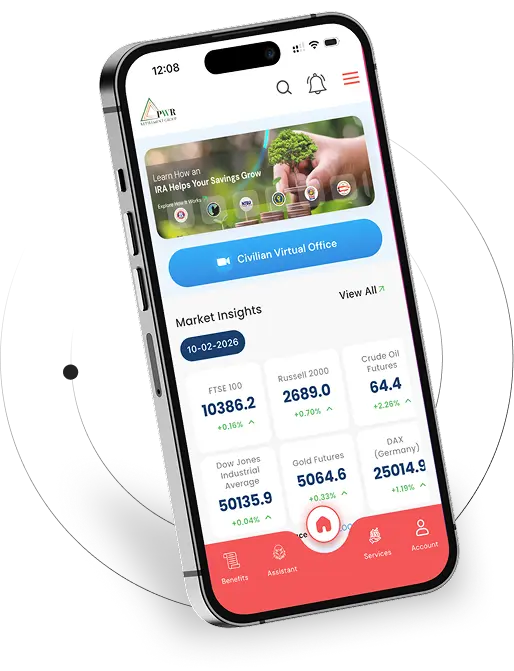
PWR puts your retirement planning, benefits guidance, and financial tools in one secure app. Access everything easily, track your progress in real time.
Every financial journey is different. PWR focuses on your goals, benefits, and timeline—delivering guidance built around you, not a generic plan.
PWR gives you access to workshops, live events, and podcasts that simplify complex financial topics into clear, practical insights.
The Power Banking Concept helps individuals and business owners think differently about how money is saved, accessed, and used. With the right structure, it can support liquidity, future opportunities, emergency planning, and long-term financial flexibility while keeping your overall strategy organized and aligned with your goals.